FAI and Hip Labrum Tear Specialist
Femoroacetabular impingement (FAI), or hip labrum tears can cause pain and difficulty in sports or even day to day living. Pain in the groin area and outer thigh can be an indication of hip impingement or a labral tear. Selecting a specialist with experience in treating Femoroacetabular Impingement (FAI) is crucial to a positive outcome. Doctor Prem Ramkumar, labral tear and hip impingement specialist, is located in Long Beach and serves patients in Los Angeles, Orange County, and surrounding Southern California areas. Contact Dr. Ramkumar’s office today!

What is femoroacetabular impingement (FAI)?
The femur (thigh bone) and the pelvis (hip bone) are the two bones that make up the hip joint. Often referred to as a ball and socket, the ball-shaped surface of the femoral head fits into a cup-like depression of the pelvic bone. Smooth cartilage connects the bones, stabilizing the joint and making it easy to move.
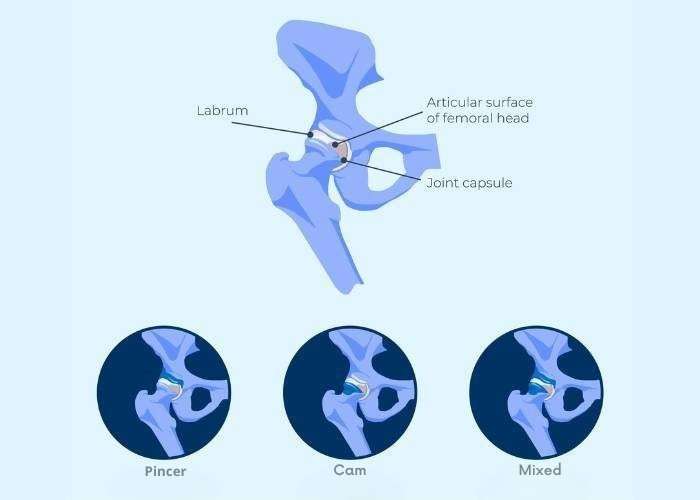
Femoroacetabular impingement (FAI) occurs when extra bone develops around the femoral head and/or along the acetabulum. This abnormal bone prevents the hip joint from moving smoothly, causing the labrum to tear, the articular cartilage to break down, and resulting in stiffness and discomfort for the patient. This abnormal bone arises from open growth plates that are present in adolescence and young adulthood and are triggered from overactivity, particularly ones involving squatting, lunging, and repetitive hip flexion. When untreated, this hip impingement leads to early arthritis.
By addressing hip impingement early, there is a high likelihood of improving range of motion, pain, and even potentially lowering the risk of of arthritis. Dr. Prem Ramkumar, FAI specialist, is located in Long Beach and serves patients in Los Angeles, Orange County, and surrounding Southern California areas.
Dr. Ramkumar’s Perspective
“I often describe hip impingement as a square peg in a round hole. The hip is designed to be a smooth ball-and-socket joint, but extra bone can change that relationship and create contact during certain movements.”
What causes hip impingement?
Femoroacetabular impingement occurs when the free ranging ball-and-socket hip joint becomes a square peg in a round hole, resulting in stiffness. This stiffness results in added stress to adjacent joints – like the lower back, knee, pelvis, and other hip – to do more to make up for the limited hip. Many people with femoroacetabular impingement do not realize they have it as the spectrum of pain and stiffness present variably in the population.
As previously mentioned, athletes are more prone to hip impingment, or FAI, given the repetitive hip exercises during the critical period in adolescence and young adulthood when growth plates are open. In particular, soccer, hockey, softball, lacrosse, and track and field are particularly notorious for hip impingement. Early diagnosis and treatment of hip impingement with an experienced hip specialist like Dr. Ramkumar can help you better decide how to manage your symptoms.
Below is an image demonstrating the development of hip impingement during adolescent athletics in a 12 year old and 14 year old. The development of cam morphology can be seen, as well as obvious injury to the articular cartilage.
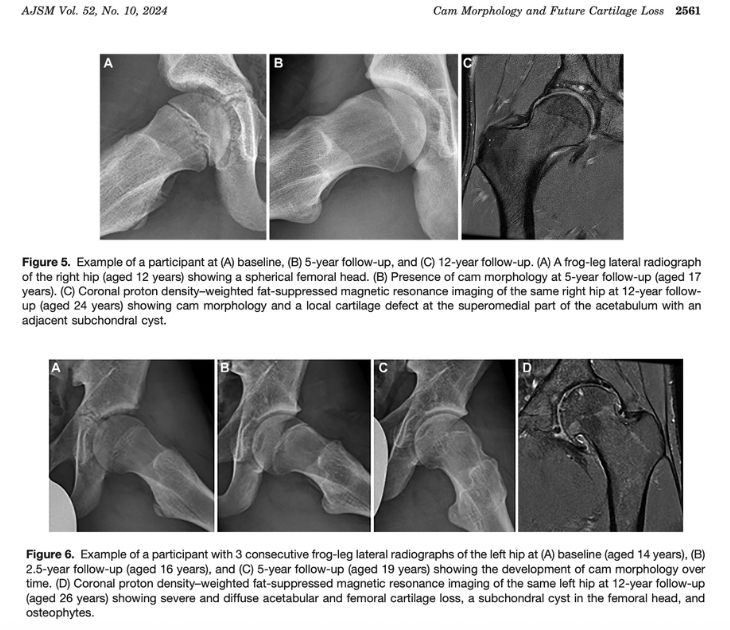
Image Source: Claes PAM, Hanff DF, Weir A, et al. The Association Between the Development of Cam Morphology During Skeletal Growth in High-Impact Athletes and the Presence of Cartilage Loss and Labral Damage in Adulthood. Am J Sports Med. 2024;52(10):2555–2564. doi:10.1177/03635465241256123. Licensed under CC BY 4.0.
What are the different kinds of femoroacetabular impingement (FAI)?
There are three types of femoroacetabular impingement.
- Cam Impingement: A bump forms on the edge of the ball of the femur, leading to excessive grinding against the joint’s cartilage. Because the joint no longer moves freely, it injures the articular cartilage and results in a labrum tear.
- Pincer Impingement: Extra bone forms out over the normal rim of the acetabulum, which can crush the labrum and damage the femoral head.
- Mixed Cam and Pincer Impingement: This means a patient has both types of impingements in the joint. This is the most common type of impingement.
What are the symptoms of femoroacetabular impingement (FAI)?
Symptoms of femoroacetabular impingement include pain with sitting, a limp when walking, stiffness with limited hip range of motion, catching, and clicking. Other symptoms are:
- Pain in the groin and outer thigh area, especially when the hip is flexed and internally rotated.
- Pain that radiates to the outside of the hip and even to the low back or knee.
- Pain that can range from a dull ache to sharp intense stabbing.
Why does my hip click or pop when I squat?
Squatting is a core activity for overall health and wellness, which is one reason Dr. Ramkumar considers clicking, popping, snapping, or pinching during a squat worth evaluating carefully. He first distinguishes between painless and painful snapping or pinching and then determines where the snapping or pinching is occurring.
If there is pain in the front of the hip, specifically near the groin, Dr. Ramkumar says this is often FAI. It may not be painful, but it could be uncomfortable. He also checks to make sure other concomitant issues and pain generators are not being missed, including one-sided low back pain, thigh pain, groin pain, lateral thigh pain, or anterior knee pain. He also performs an exam to assess stability and stiffness of the hip joint.
If the snapping is on the outside of the hip (lateral hip) and can be visibly seen, Dr. Ramkumar is more suspicious for problems related to the IT band. He notes that IT band-related snapping usually does not require surgery.
Dr. Ramkumar adds that it is “absolutely critical not to miss hip impingement (FAI)” because this is one of the few diagnoses that many hip specialists believe leads to premature hip arthritis.
Dr. Ramkumar’s Perspective
“First, it’s important to distinguish between painless and painful snapping or pinching. Second, it’s important to delineate where the snapping or pinching is occurring.”
Why do I feel a sharp pinch in the front of my hip when I squat?
Dr. Ramkumar says a sharp pinching sensation in the front of the hip or groin during a deep squat is “pretty much always indicative of hip impingement,” assuming the patient has not already had the joint replaced. He says this pinching sensation is exceedingly common among athletes because the shape of the hip can change during adolescence to accommodate intense physical activity. We are typically born with a hip that should be a round peg in a round hole, but impingement creates a square peg in a round hole. This process leads to labral and articular cartilage injury.
Dr. Ramkumar also notes an important exception: after hip surgery, pinching and catching in the front of the hip can be quite normal and is often painless, which may be indicative of scar tissue and tissue remodeling.
Dr. Ramkumar says FAI can often be fixed with a minimally invasive hip arthroscopy, and it is important to identify FAI or hip impingement early for multiple reasons, including:
- Patients do not have to live with the pain.
- Hip impingement surgery, by way of hip arthroscopy, can improve the range of motion of the native hip joint and describes this as “the only orthopaedic surgery that adds motion to a native hip joint.”
- If you are an athlete, there is “a pretty good chance that you will be a better and safer athlete after hip impingement surgery.”
- Addressing hip impingement may alleviate problems in adjacent joints, including lumbar disc herniations, meniscus tears, and ACL tears. (See “Restriction in hip internal rotation is associated with an increased risk of ACL injury“.)
- Fixing hip impingement may help decrease the risk of hip osteoarthritis in 25% of patients. (See “Minimally Invasive Procedure Can Delay Arthritis“.)
When evaluating sharp pinching with a squat, he usually checks hip motion and concomitant issues such as lower back pain, anterior knee pain, and thigh pain.
Dr. Ramkumar’s Perspective
“Sharp pinching in the front of the hip, particularly with a squat, warrants a thorough FAI or hip impingement evaluation with a hip specialist.”
Why won’t my groin pain go away after a leg workout?
Dr. Ramkumar says, “Groin pain after a hard leg workout is never normal and should never be ignored, especially if this persists.” True muscle strains are common, dissipate over a span of days, and do not usually recur with a workout. If the pain recurs or nags, he says these muscle strains are often signs of a reaction to a deeper issue at the hip joint, known as the “osteoarticular layer.”
He explains this as FAI or hip impingement, where the ball-in-socket joint is now a square peg in a round hole. He says this is problematic because the articular cartilage is silently injured, which patients and other providers may explain away as “stiff hips” or “tight hips.” This often leads to pain when the labrum is sufficiently injured. Dr. Ramkumar explains that the articular cartilage of the hip does not have pain receptors to communicate to the patient, so the labrum is the second injury that occurs and says its “sole purpose is to communicate pain to the patient.”
Dr. Ramkumar emphasizes that by the time there is pain, there may already be silent, focal injury to the articular cartilage that cannot be regrown or restored.
Dr. Ramkumar’s Perspective
“True muscle strains are common and dissipate over a span of days and do not usually recur with a work out. If it recurs or nags, these muscle strains are often signs of a reaction to a deeper issue at the hip joint.”
Why can FAI or a labral problem become painful with prolonged sitting?
Dr. Ramkumar says FAI or a labral problem is often painful with prolonged sitting in a car, at a desk, or on a plane.
He explains that when we are born, we often have hips that are round balls (femoral head) articulating with a round socket (acetabulum), creating a smooth and congruent interface. During adolescence, the hips have open growth plates, usually between the ages of 14 and 22. These open growth plates are areas in the bones that are capable of adding bone to allow growth.
As adolescents play sports and increase activities involving the muscles and bones of the hip, Dr. Ramkumar says the hips can interpret this additional stress as a signal to lay down more bone around the hip to protect it from the stresses of athletics and activities. This additional bone changes the round peg in a round hole into a square peg in a round hole.
During sitting or squatting positions, he explains that the aspherical bump of the femoral head can inappropriately grind the socket and cause damage to the articular cartilage and labrum.
Why does my hip hurt when I run but not when I walk?
Patients with FAI can have hip, groin, low back, or anterior knee pain while walking or running. Dr. Ramkumar says it is often more common during running because the hip flexes more with running than walking. This increased flexion introduces the cam lesion (or aspherical bony bump) into the socket and is more likely to injure the articular cartilage and labrum about the hip.
Although runners can have hip pain in the middle of the run, Dr. Ramkumar often sees patients complain of pain before or after the run.
In his experience, runners are often not only running athletes. They are frequently multidisciplinary athletes who participated in track or other sports, which means that during adolescence they loaded their hips and developed cam lesions that predisposed them to FAI or hip impingement.
Dr. Ramkumar’s Perspective
“Often times, patients will tell me that they have stiff or tight hips during the warm up but smooth during the actual run. Conversely, runners will tell me that they have pain after the run, whether it’s hours or days later.”
Why does my hip feel stiff, locked, or difficult to move after sitting?
Dr. Ramkumar says, “Despite what you read online, hip stiffness is never normal.” Hips can feel stiff, locked, or tight to move after sitting or getting out of a chair for patients with hip conditions of any age. In younger patients, particularly among athletes, hip or low back stiffness is extremely common with FAI or hip impingement.
He again points to the development of the hip during adolescence. The hips have open growth plates, usually between the ages of 14 and 22, which are capable of adding bone as we grow. As adolescents play sports and increase their activity, Dr. Ramkumar says the hips can interpret this additional stress as a signal to lay down more bone around the femoral head and acetabular rim to protect the joint from the stresses of athletics and activities.
This extra bone formation changes the round peg in a round hole into a square peg in a round hole. After sitting, he explains that the aspherical bump of the femoral head can inappropriately grind the socket and cause damage to the articular cartilage and labrum.
This can cause catching or locking because the hip is no longer moving smoothly due to the abnormal bone around the hip joint. In Dr. Ramkumar’s explanation, the nature of having a square peg in a round hole is damage to the articular cartilage; when this becomes painful, the labrum is involved.
Dr. Ramkumar’s Perspective
“In younger patients, particularly among athletes, hip or low back stiffness is extremely common with FAI or hip impingement.”
How is femoroacetabular impingement (FAI) diagnosed?
Dr. Ramkumar will conduct a detailed physical examination and perform an impingement test. During this test, the knee is moved closer to the chest and then rotated toward the opposite shoulder. If you experience hip pain, you may receive a femoroacetabular impingement diagnosis. Dr. Ramkumar will also use X-rays, MRI, CT scan, and even an injection to confirm the diagnosis and examine the shape of the hip bones, cartilage, labrum, and other structures in and around the hip joint.
How is femoroacetabular impingement (FAI) treated?
Treatment for femoroacetabular impingement depends on the severity of symptoms. Dr. Ramkumar favors non-surgical treatments before considering any surgical intervention.
Non-surgical treatments may include:
- Activity modification – Avoiding activities that cause symptoms.
- NSAIDs – Drugs such as Ibuprofen may help reduce pain and inflammation.
- Physical Therapy – This can help strengthen hip joint muscles and improve range of motion.
Dr. Ramkumar may also recommend a hip joint injection for long-term pain relief.
Surgical treatments:
If conservative treatments fail and symptoms persist, surgical intervention may be necessary. Dr. Ramkumar will perform an arthroscopic procedure to treat FAI that is referred to as acetabuloplasty . The goal is to reduce pain and prevent future hip joint damage. Dr. Ramkumar will make a small incision in the hip and use tiny surgical instruments to repair the labrum and reshape the hip joint to remove abnormalities causing the mechanical impingement. Not all FAI damage is fixable with surgery, which is one reason you should seek treatment early.