Partial and Total Knee Replacement Surgeon
If knee pain is limiting your activity, it may be time to explore your options. An early evaluation can determine whether you’re a candidate for a partial knee replacement or if a total knee replacement is the better path forward. Prem Ramkumar, MD specializes in personalized, bone-preserving treatment strategies designed to restore function and help you get back to the activities you enjoy. Patients in Long Beach, Los Angeles, Orange County, and Southern California surrounding areas can schedule a consultation today to learn which approach is right for you. Give us a call!

Do You Need a Total Knee Replacement? Understanding Partial vs Total Knee Replacement
Knee arthritis doesn’t affect every patient the same way and it does not always require the same solution. For some individuals, especially when arthritis is limited to one area of the knee, a partial knee replacement may offer an effective alternative to a total joint replacement.
Understanding the difference between a partial total knee replacement and a total knee replacement can help you make a more informed decision about your care and whether it’s possible to avoid a total knee replacement altogether.
Avoiding Total Knee Replacement: When Is a Partial Knee Possible?
Not every patient with severe knee arthritis needs a total knee replacement. In fact, if arthritis is isolated to one compartment of the knee; medial, lateral, or patellofemoral, a partial knee replacement may be an option.
A partial knee replacement focuses only on the damaged portion of the joint while preserving healthy bone, ligaments, and natural knee mechanics. Because of this, many patients feel that their post-surgery knee feels more “normal” and their recovery is much faster. Specifically, the ACL and PCL are preserved in a partial knee replacement, which are routinely sacrificed in full knee replacements. Additionally, two-thirds of the bone and cartilage are preserved.
It is important to understand that that partial knee replacement is not the best choice for everyone. Partial replacement also requires a surgeon who has specialized training and experience on performing this type of surgery. Partial knee replacements are technically demanding, and are only appropriate for specific patterns of arthritis. This is why partial knee replacements are performed less nationwide than total replacements. Also, there always exists the risk that patients with partial knee replacements may go on to conversion to full knee replacement if subsequent arthritis or injury occur. While some may argue that it may be better to “just be done with it” and go for the full knee replacement, the complications after a full knee replacement are much larger than after a partial knee replacement.
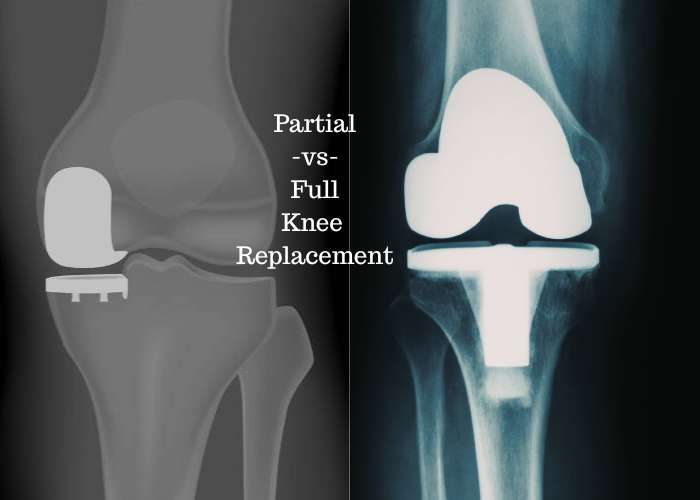
What Is a Partial Knee Replacement?
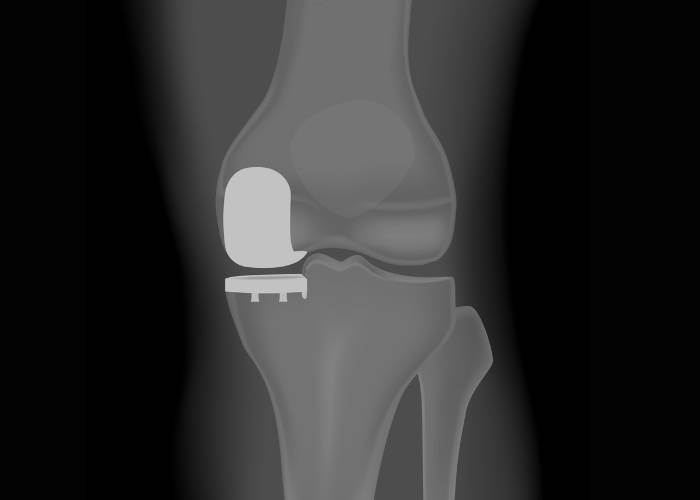
A partial knee replacement, also known as a unicompartmental knee arthroplasty (UKA), resurfaces only the damaged portion of the knee while leaving the rest of the joint intact. The resurfaced, or damaged/arthritic surface is replaced with a partial knee prosthesis.
Benefits of a partial knee replacement may include:
- Preservation of healthy bone and ligaments
- More natural knee movement
- Faster recovery compared to total knee replacement
- Less disruption to surrounding tissues
- Fewer complications related to instability
This makes it an appealing option for patients looking for alternatives to total knee replacement when appropriate.
Drawbacks of a partial knee replacement may include:
- Need for subsequent conversion to a total knee replacement (3-5% risk 20 years later)
- Slightly increased periprosthetic fracture risk compared to a total knee replacement
What Is a Total or Full Knee Replacement?
A total knee replacement or TKA (Total Knee Arthroplasty) involves resurfacing all three compartments of the knee joint and replacing them with a prosthesis, or metal parts. It is typically recommended when arthritis is more widespread and affects multiple areas of the knee.
This procedure is highly reliable and effective for relieving pain and improving function in patients with diffuse arthritis with severe joint instability or deformity.
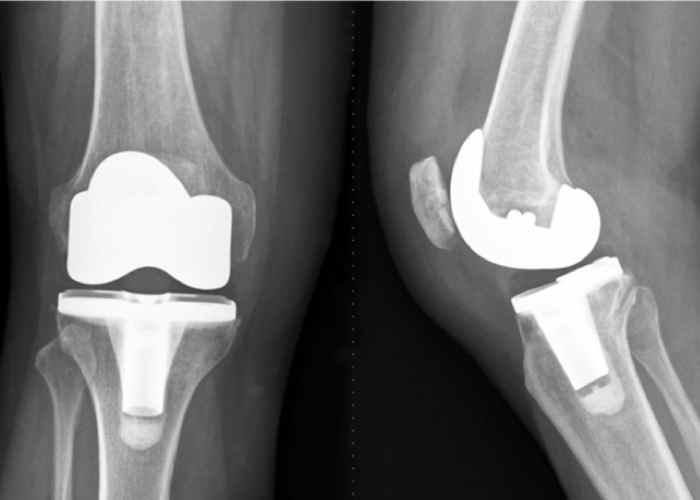
Partial vs Total Knee Replacement: Key Differences
When comparing partial vs total knee replacement, the most important differences come down to how much of the knee is treated and how much of the natural joint is preserved.
- Partial knee replacement treats only the damaged area and preserves normal structures
- Total knee replacement addresses the entire joint when arthritis is more extensive
- Recovery from partial knee replacement is often quicker and more natural-feeling due to retention of your natural parts
- Total knee replacement is more widely applicable across different arthritis patterns
- If a failure of either surgery occur, the surgical options after a partial knee is simply a total knee replacement; however, the surgical options after a full knee involves large prostheses with stems that remove more bone in your femur and tibia.
Choosing the right procedure depends on your anatomy, activity level, and the extent of your arthritis. Further consideration is given to which compartment of the knee has early arthritis, how advanced it is and if it can be repaired/replaced by itself.
Who Is a Candidate for a Partial Knee Replacement?
You may be a candidate for a partial knee replacement if:
- Arthritis (meniscus and/or cartilage damage) is limited to a single compartment of the knee
- Your ligaments (especially the ACL) are intact
- You maintain near-normal range of motion
- You do not have severe, uncorrectable deformity
- Your femur and tibia are not subluxed or grossly unstable on x-rays
- Non-surgical treatments have not provided relief
A detailed evaluation, including imaging and physical examination, is essential to determine if the partial knee replacement approach is right for you and your very active lifestyle. Dr. Ramkumar will help you understand your partial knee replacement candidacy.
High-Performance Athletes and Partial Knee Replacements
For active individuals and athletes, preserving natural knee function is especially important. In select cases, partial knee replacement can allow patients to maintain a higher level of activity compared to total knee replacement.
Because this procedure preserves key stabilizing structures of the knee, it can feel more natural during movement which is an important consideration for those who want to stay active. A well-known example is elite skier Lindsey Vonn, who underwent a partial knee replacement and returned to a high level of performance. Her story highlights how, in the right patient, this procedure can support both recovery and a return to demanding physical activity.
Choosing the Right Approach: Partial Knee Replacement or Total Knee Replacement
While many patients are interested in avoiding total knee replacement, the most important factor is choosing the procedure that will provide the best long-term outcome and best match your athletic/active lifestyle.
Partial knee replacement offers clear advantages for the right candidate, but it is not appropriate for everyone. Working with an experienced orthopedic surgeon like Dr. Ramkumar, who specializes in both techniques, ensures that your treatment is tailored to your specific condition and goals.
Final Thoughts on Partial or Total Knee Replacement:
If you are searching for alternatives to total knee replacement, a partial knee replacement may be an excellent option, IF you are active and IF you meet the strict criteria. The key is early evaluation and proper diagnosis, which can open the door to more conservative, joint-preserving solutions and help you return to the activities you enjoy. Dr. Prem Ramkumar offers expert evaluation around partial knee replacement and advice as well as the best options for knee pain and knee injuries.
Partial Knee vs Total Knee Replacement: What’s the Difference?
| Feature | Partial Knee Replacement | Total Knee Replacement |
|---|---|---|
| Portion of Knee Replaced | Only the damaged compartment (medial, lateral, or patellofemoral) | All three compartments of the knee |
| Healthy Bone & Ligaments | Preserved | Removed and replaced with implants |
| Surgical Approach | Smaller incision, less bone removal | Larger exposure, full joint resurfacing |
| Recovery Timeline | Often faster return to walking and daily activity | Slightly longer recovery period |
| Knee Motion & Feel | May feel more “natural” because native ligaments remain intact | Stable and reliable, but replaces entire joint mechanics |
| Best For | Arthritis isolated to one compartment | Arthritis affecting multiple compartments |
| Longevity | Excellent survivorship in properly selected patients | Excellent long-term durability |
| Future Options | Can be converted to total knee if arthritis progresses | Revision surgery possible if needed |