Buttock Pain (Deep Gluteal Pain) Specialist
If you’re dealing with persistent buttock, hip, or radiating leg pain and still don’t have clear answers, it may be time for a specialized evaluation. Prem Ramkumar focuses on identifying the true source of complex hip and nerve-related pain, including deep gluteal pain syndrome and ischiofemoral impingement. Schedule a consultation to get an accurate diagnosis, a personalized treatment plan, and a clear path back to comfortable movement.

What is Deep Gluteal Pain Syndrome (DGPS or DGS)?
Deep gluteal pain syndrome, DGPS or DGS is a hip condition that can cause deep pain in the buttock that radiates down the leg. The pain often interferes with sitting, walking or athletic activity. DGS occurs when structures deep in the buttocks, or gluteal space, compress on the sciatic nerve. This can be caused by ischiofemoral impingement syndrome (IFI) which is a mechanical narrowing between the hip bones, causing nearby muscles and nerves to compress or become pinched.
The two conditions, DGS and IFI often overlap, so it is important to get an accurate diagnosis to obtain the best and most effective treatment.
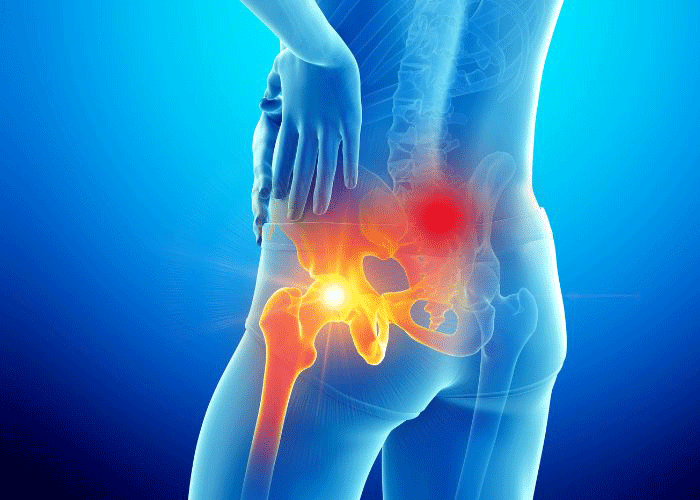
What is (and is not) Deep Gluteal Pain Syndrome?
Deep gluteal pain syndrome is not a single injury, it is a group of conditions that produce pain in the deep buttock region due to irritation of the sciatic nerve outside the spine. Unlike classic sciatica caused by spinal disc problems, DGPS originates in the hip or pelvic region. Common anatomical contributors can include:
- Tight or inflamed deep hip muscles
- Fibrous bands compressing the sciatic nerve
- Prior injury or scar tissue
- Structural narrowing within the hip
- One specific structural cause of nerve compression is ischiofemoral impingement, which involves abnormal narrowing between two bones near the hip joint.
What is Ischiofemoral Impingement in the hip?
There are bony prominences along the bottom of the pelvis, known as the ischial tuberosities or “sitting bones.” These bones serve as the attachment site for the hamstring muscles. The lesser trochanter, a bony prominence on the inner thigh bone, sits adjacent to these “sitting bones”. The space between these bony processes can narrow which results in compression of the muscles and nerves. This causes a painful hip condition known as ischiofemoral impingement. Dr. Prem Ramkumar, orthopedic hip specialist serving patients in Long Beach, Los Angeles, Orange County, and Southern California surrounding areas has the knowledge and understanding as well as substantial experience in treating patients who have experienced ischiofemoral impingement.
What causes Deep Gluteal Pain Syndrome or Ischiofemoral Impingement?
Deep Gluteal Pain Syndrome (DGS) and Ischiofemoral Impingement (IFI) are caused by compression of the sciatic nerve or soft tissues (like the quadratus femoris muscle) between the hip bone, femur, or surrounding structures. Key causes include:
- Prolonged sitting
- Excessive exercise
- Traumatic injury
- Hip osteoarthritis
- Structural changes following hip surgery.
- Muscle imbalances or hip weakness
What are the symptoms of DGS or IFI?
Deep gluteal pain syndrome and ischiofemoral impingement syndrome affect similar structures, because of this, the symptoms often overlap. Patients frequently report:
- Deep buttock pain, especially when sitting
- Pain radiating down the leg
- Discomfort with walking or running
- Hip stiffness or snapping sensations
- Pain with forward bending or hamstring stretching
- Changes in gait or limping
Symptoms may worsen during activity and improve with rest, but persistent or progressive pain should be evaluated by Dr. Ramkumar.
How are Gluteal Pain Syndrome or Ischiofemoral Impingement Syndrome Diagnosed?
Accurate diagnosis starts with a detailed history and physical examination. Dr. Ramkumar will conduct specific movement tests and will determine whether pain is coming from the spine, hip joint, or deep gluteal space. He may request imaging studies such as MRI, Ultrasound or x-rays to help identify the issue.
What is the treatment for Deep Gluteal Pain or Ischiofemoral Impingement?
Non-surgical Treatment:
Most patients are able to improve with conservative care, especially when treatment targets the underlying cause. This may include:
- Activity modification
- Anti-inflammatory medications
- Guided physical therapy
- Targeted strengthening programs
- Image-guided injections
Rehabilitation is especially important because restoring muscle balance can relieve pressure on the sciatic nerve.
Surgical Treatment for IFI or DGS:
If conservative treatment fails to relieve pain and restore function, surgical treatment may be needed to relieve compression on the muscles and nerves and restore normal movement. Surgical options may include:
- Lesser trochanter decompression to widen the ischiofemoral space
- Ischial tuberosity reshaping to remove bony impingement
- Endoscopic sciatic nerve decompression
- Corrective femoral osteotomy for structural alignment problems
These procedures are typically performed using minimally invasive techniques whenever possible.
Why it is important to get the right diagnosis for your hip or buttock pain:
Deep gluteal pain syndrome is frequently misdiagnosed because the symptoms mimic lumbar spine problems, hamstring injuries, or general hip pain. It is important to identify whether ischiofemoral impingement is contributing to the pain. It is essential because treatment strategies differ.
When the true source of pain is addressed, patients often experience faster relief, better mobility, and a more predictable recovery.
When to see a hip specialist for deep buttock pain:
If buttock or hip pain persists, radiates down the leg, or limits activity, evaluation by Dr. Ramkumar is essential. He has specialized training and experience treating deep gluteal conditions which can make a big difference in outcomes for his patients. Early diagnosis allows targeted treatment before symptoms worsen or become chronic.